Below is the list of books I have worked on.
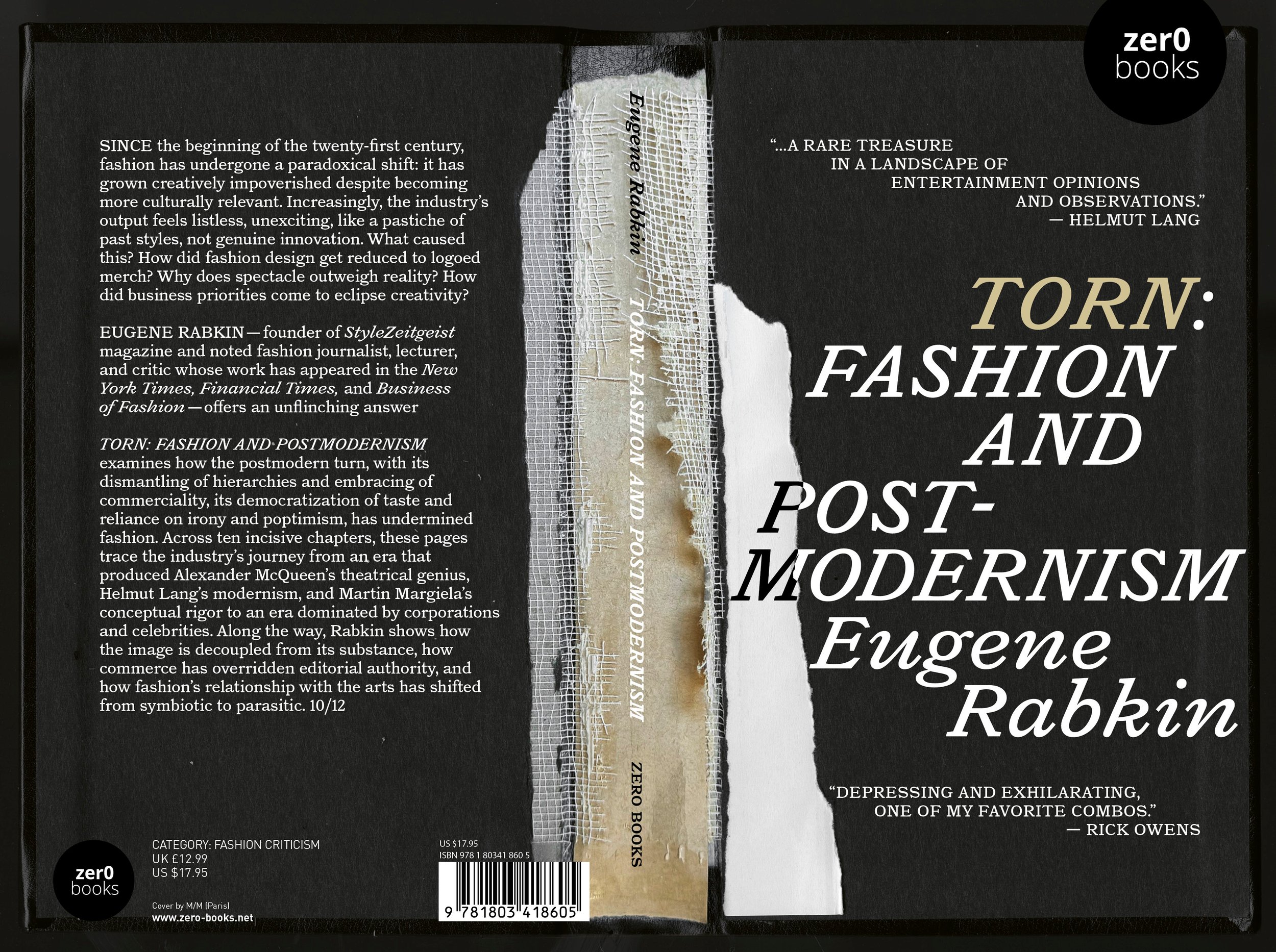
Torn: Fashion and Postmodernism (Zer0 Books) PREORDER BELOW!
Well, it finally happened, I wrote a book. When Zer0 approached me to write their first title about fashion, I could hardly believe it. As and admirer of Mark Fisher’s Capitalist Realism: Is There No Alternative, I could not think of a better imprint than the one he founded. I knew immediately what I wanted to write about, the pernicious effects of postmodern mindset and postmodernist culture on fashion of the past 25 (but mostly the past 15) years. for years I’ve been thinking about whether there is an underlying reason for fashion’s impoverishment that so many of us have been witness to. Time and again, the answer to me seemed to be, in a word, postmodernism.
I’ve been delighted with how many people got behind the book. The cover is designed by M/M (Paris), the preeminent creative agency responsible for much of iconic fashion imagery. Helmut Lang, Rick Owens, Hussein Chalayan, Angelo Flaccavento, Dr. Valerie Steele, and W. David Marx provided endorsements. And so many others wished me well on this journey.
Here is the synopsis for Torn: Fashion and Postmodernism:
“Since the beginning of the twenty-first century, fashion has undergone a paradoxical shift: it has grown creatively impoverished despite becoming more culturally relevant. Increasingly, the industry’s output feels listless, unexciting, like a pastiche of past styles, not genuine innovation. What caused this? How did fashion design get reduced to logoed merch? Why does spectacle outweigh reality? How did business priorities come to eclipse creativity? Eugene Rabkin offers an unflinching answer. Torn: Fashion and Postmodernism examines how the postmodern turn, with its dismantling of hierarchies and embracing of commerciality, its democratization of taste and reliance on irony and poptimism, has undermined fashion. Across ten incisive chapters, these pages trace the industry’s journey from an era that produced Alexander McQueen’s theatrical genius, Helmut Lang’s modernism, and Martin Margiela’s conceptual rigor to an era dominated by corporations and celebrities. Along the way, Rabkin shows how the image is decoupled from its substance, how commerce has overridden editorial authority, and how fashion’s relationship with the arts has shifted from symbiotic to parasitic.”
You can preorder the book on Amazon in the US / UK / EU, and on Barnes & Noble, Indigo in Canada, and Waterstones in the UK.

The Antwerp Six (Hannibal, 2026)
I was thrilled when MoMu fashion museum in Antwerp asked me to contribute an essay to the catalogue that accompanied the exhibition celebrating the 40th anniversary of The Antwerp Six. I wrote a sprawling text outlining the influence of the Antwerp Six on the ‘90s fashion and the unique cultural moment that was receptive to their ideas. Having fallen in love with conceptual fashion during that decade in large part due to The Antwerp Six, Ann Demeulemeester especially, this was a true full circle moment for me.

Stone Island: Storia (Rizzoli, 2020)
One of the most exciting things I’ve worked on, this is the first monograph that tells the history of this storied brand with a worldwide cult following. It’s also the first major title I edited, while also contributing an in-depth text about the history and design methods of this innovative label. Truly, a dream project!

The New Luxury (Gestalten, 2019)
The second Highsnobiety book came fast on the heels of the first. For this one, the editors asked me to dive in more into the story of Stone Island, and so I wrote the case study of the brand for it.

The Incomplete Highsnobiety Guide to Street Fashion and Culture (Gestalten, 2018)
When Highsnobiety was offered to do their first book with Gestalten, they asked if I would contribute several articles to it, namely on Rick Owens, Undercover, and Stone Island. Which is almost exactly what I did. Almost, because I thought that Rick should tell about his take on the bomber jacket in his own words, which is exactly what he did.

Deborah Turbeville Comme des Garcons 1981 (IDEA Books, 2017)
This book was born by chance. One day in the winter of 2017 I was browsing in the archives of the photographer Deborah Turbeville, where I stumbled on a box that said "Comme des Garcon 1981" [sic] on it. I opened it and inside was a treasure trove of images Turbeville took of what, judging by the year, must have been the first or second Comme des Garcons collection presented in Paris. I immediately knew I had something special on my hands. At the time, the Met Museum already announced its upcoming exhibition on Comme des Garcons. It was about four months away. I knew I had a book on my hands, and I knew that IDEA were the right people to turn it around in such a short time frame. And they did. It's an intimate book that is a lovely memory of Deborah, whom I knew only briefly before she passed away. I can only say that I am proud to have contributed to her memory.
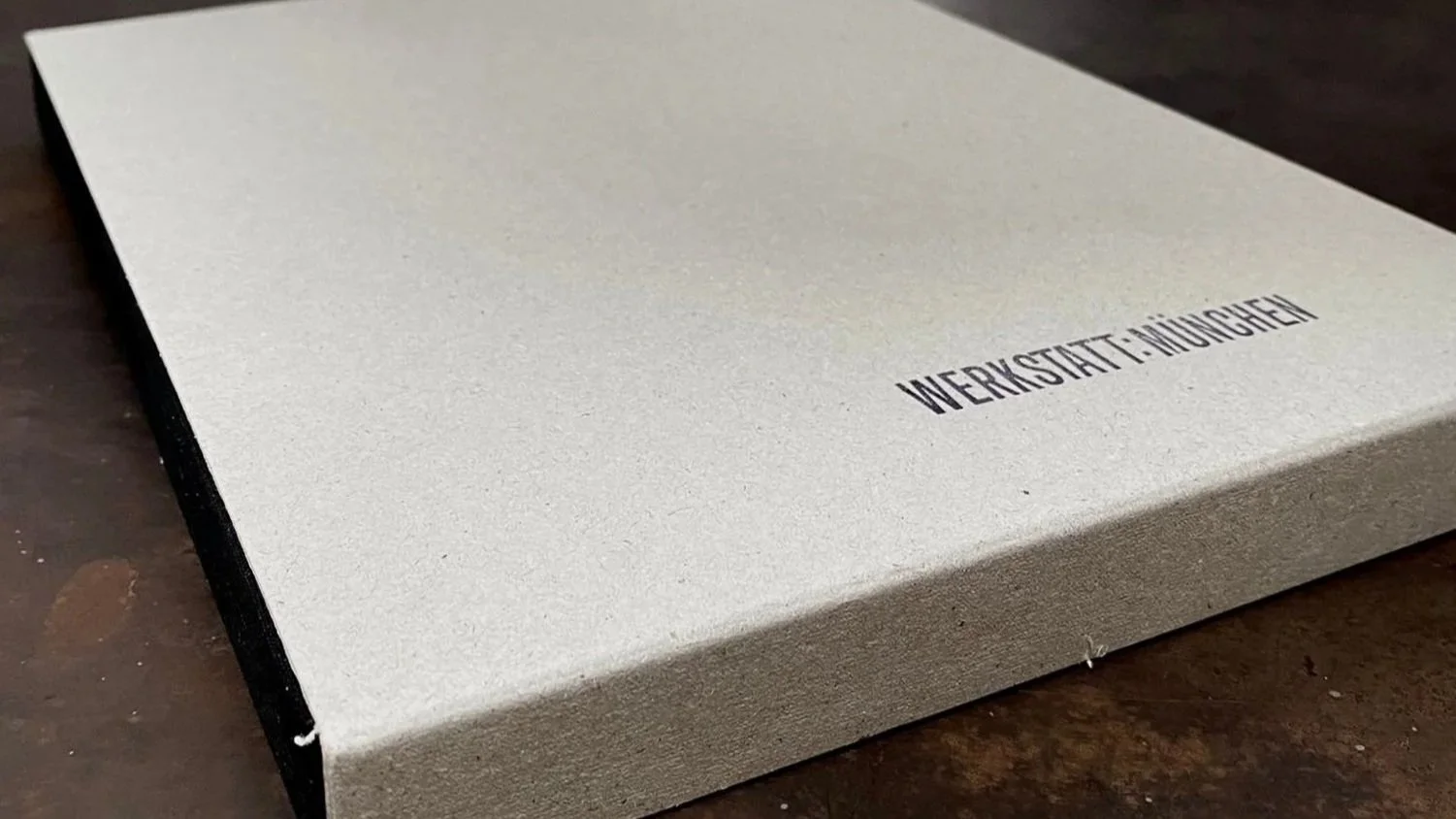
Werkstatt:Munchen (Self-Published, 2021)
When Klaus Lohmeyer, the founder of my favorite jewelry brand Werkstatt:Munchen, approached me to make a book for the 25th anniversary of the brand, I could not say no. Making a book during the pandemic was its own challenge, but I put a skeleton crew / dream team together, including my long-time collaborator Florian Schmitt, who art directed and designed the book and Matteo Carcelli, one of my favorite photographers. Many Zoom meetings and Miro boards later we had this thing on lockdown, and it turned out beautifully artisanal, just like W:M jewelry.

Boris Bidjan Saberi (Atlantic, 2013)
My first foray into books was in 2013, when Boris Bidjan Saberi asked me to contribute an essay to his monograph. Now a collector’s item, it documents Saberi’s first years of work.